
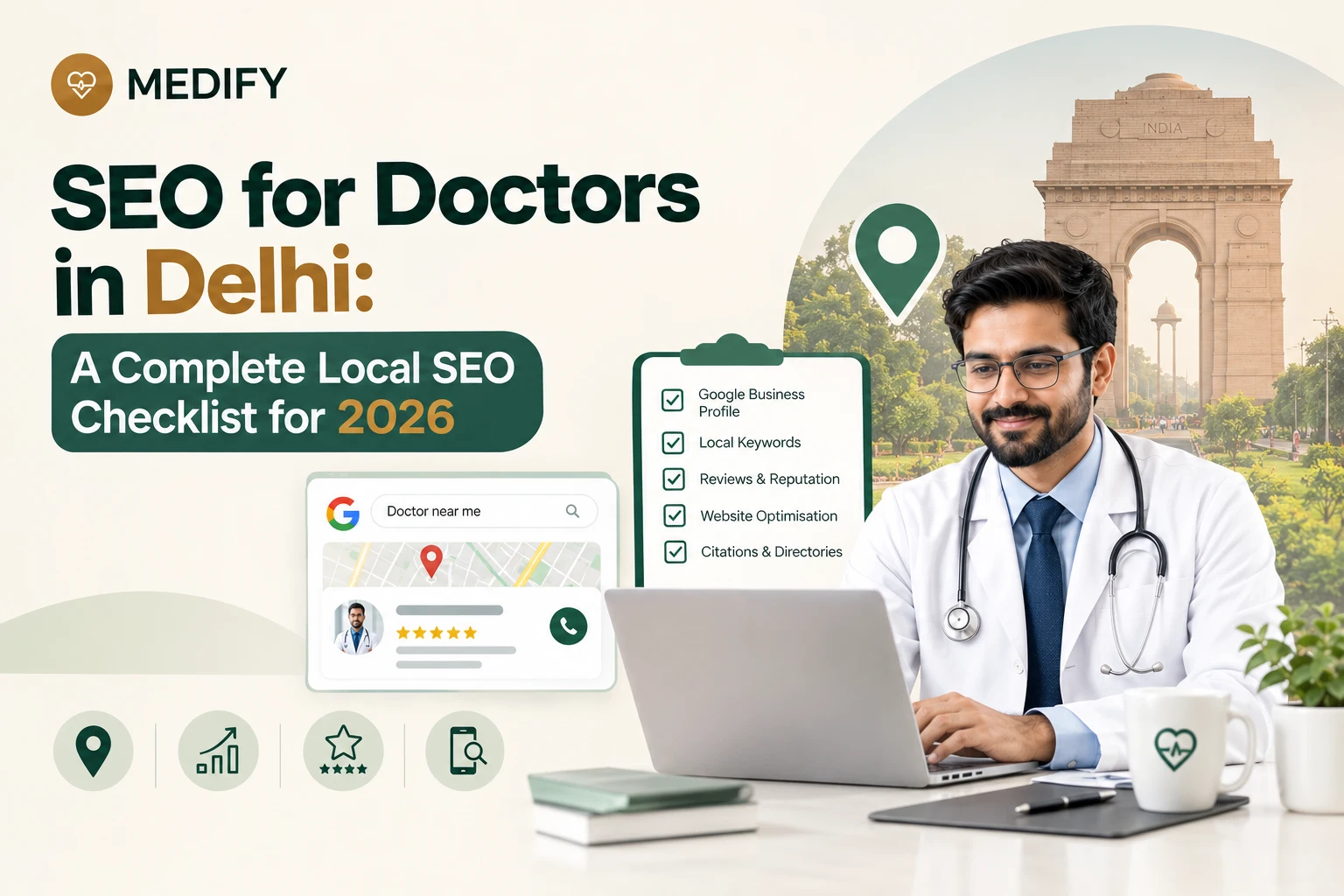
If you search your own speciality and neighbourhood right now — “best cardiologist Rajouri Garden” or “dermatologist near Saket” — and you’re not on the first page, that’s not bad luck. It usually means one or two specific, fixable things are missing. This is a practical checklist for doctors in Delhi who want to actually understand why they’re not showing up, and what to fix first.
Why Most Doctors Aren’t Showing Up on Google
Three reasons account for the vast majority of cases:
- An unclaimed or poorly optimised Google Business Profile — the single biggest factor in local search visibility for doctors, and the one most commonly ignored.
- A website with no real SEO foundation — thin content, missing location and speciality keywords, slow load times, or no mobile optimisation.
- Too few reviews, or reviews with no responses — Google factors review volume, recency, and engagement into local rankings, not just star rating.
Fix these three and most doctors see a meaningful shift in visibility within a few months — no shortcuts, no black-hat tricks, just doing the fundamentals properly and consistently.
Step 1: Get Your Google Business Profile Right
This matters more for doctors than almost any other business category, because most patient searches are hyper-local (“near me” or “in [neighbourhood]”).
- Claim and verify your profile if you haven’t already.
- Fill in every field — speciality, sub-specialities, consultation hours, accepted insurance if applicable, clinic photos, and your profile photo.
- Choose the most accurate primary category (e.g., “Dermatologist” not just “Doctor”).
- Add your exact service area if you see patients across multiple Delhi neighbourhoods.
- Post updates regularly — Google treats an active profile more favourably than a static one.
- Respond to every review, positive or negative, professionally and promptly.
Step 2: Fix the On-Page SEO Basics
Your website needs to clearly tell Google (and patients) what you do and where.
- Title tags and meta descriptions should include your speciality and location naturally — “Dr. [Name], Dermatologist in South Delhi” rather than a generic “Home” title.
- One clear page per speciality or service, not everything crammed onto a single homepage.
- Location pages if you practice across multiple Delhi areas or clinics.
- Page speed — a slow-loading site actively hurts both rankings and patient trust. Compress images, avoid heavy unnecessary scripts.
- Mobile optimisation — the majority of local health searches happen on mobile; a site that doesn’t work well on a phone loses patients before they even see your content.
Step 3: Build Local Citations and Consistency
A citation is any online mention of your practice name, address, and phone number (NAP). Search engines cross-reference these to verify legitimacy.
- List your practice consistently on Practo, Justdial, Sulekha, and relevant medical directories.
- Ensure your name, address, and phone number are identical everywhere — even small inconsistencies (a missing suite number, a different phone format) can quietly hurt local rankings.
- Get listed on hospital or clinic association pages if you’re affiliated with one.
Step 4: Content That Actually Targets How Patients Search
Generic “About Us” content doesn’t rank for the searches that matter. What does:
- Condition-specific pages answering real patient questions (“What causes chronic migraines,” “When should I see a gastroenterologist”).
- A location + speciality combination naturally worked into your key pages (“dermatologist in Delhi” style phrasing — never keyword-stuffed, just clear and natural).
- Regularly updated content — a blog with one or two well-written, genuinely useful posts a month signals an active, authoritative site far more than a static five-page website.
Step 5: Reviews — The Most Underrated SEO Lever
Review volume and recency are a direct local-ranking factor, not just a trust signal. A doctor with 80 recent, responded-to reviews will consistently outrank one with 12 reviews from three years ago, even with similar website quality.
- Build a simple system to ask every satisfied patient for a review — right after a positive consultation is the best moment.
- Respond to all reviews within a few days, including negative ones (calmly, professionally, without violating patient confidentiality).
- Never buy or fake reviews — Google actively detects and penalises this, and it violates NMC guidelines around misleading advertising.
Solo Practice SEO vs. Being Listed on a Hospital’s Website
If you practice independently, your own website and Google Business Profile carry your entire SEO weight — there’s no institutional domain authority to lean on, so every fix above matters more, and it’s worth investing proportionally more time in your own site’s content and structure.
If you’re attached to a hospital, you likely already have a profile page on their website, which typically has far more domain authority than a new independent site would. Rather than duplicating effort, the smarter move is usually to optimise your hospital profile page thoroughly (accurate speciality tags, a genuinely written bio, patient-facing FAQs) while still maintaining your own Google Business Profile as an independent listing — patients often search for you by name specifically, and you want to control that result rather than leaving it entirely to the hospital’s general listing.
How Competitive Your Search Results Are Depends on Where in Delhi You Practice
Not every speciality-plus-location search is equally hard to rank for. In areas with a high density of specialists — South Delhi searches like “gastroenterologist Saket” or “cardiologist Vasant Kunj” often show established hospital-affiliated doctors dominating the first page, competing against years of accumulated reviews and domain authority. Searches tied to less saturated pockets — parts of East or Outer Delhi, for instance — frequently have far less competition for the same speciality, meaning a well-optimised profile can break into the top three considerably faster. Before investing heavily in SEO, it’s worth honestly searching your own speciality and area to gauge how much runway you actually have, rather than assuming every search is equally difficult.
A 30-Day Quick-Start Checklist
- Claim and fully complete your Google Business Profile
- Audit your website’s title tags, load speed, and mobile experience
- Fix any inconsistent name/address/phone listings across directories
- Set up a simple system to request reviews from every satisfied patient
- Publish one genuinely useful, speciality-specific piece of content
When DIY SEO Isn’t Enough
Local SEO fundamentals can absolutely be handled yourself with consistent effort. Where most doctors hit a ceiling is technical website issues, sustained content production, and staying current as Google’s local algorithm shifts — that’s usually the point where dedicated support pays for itself. Our doctor personal branding work includes SEO as a foundation, not an afterthought, built around what actually gets doctors found in Delhi’s competitive search results.
Want to know exactly where your current visibility stands? Book a free audit and we’ll show you precisely what’s holding your rankings back.
FAQs
Why isn’t my clinic showing up on Google even though I have a website?
Having a website isn’t enough — if your Google Business Profile is incomplete, your site lacks local SEO signals, or your reviews are thin, Google has little reason to rank you above competitors who’ve done that work.
How long does local SEO take to show results for a doctor?
Most doctors see measurable improvement in local visibility within 60–90 days of consistent optimisation, assuming the Google Business Profile and website fundamentals are addressed early.
Do I need a blog to rank well locally?
It helps significantly. Regularly updated, genuinely useful content signals to Google that your site is active and authoritative, and it captures additional searches beyond your core service pages.
Can I do SEO myself as a practicing doctor with limited time?
The basics — Google Business Profile setup, review requests, and directory consistency — are manageable yourself. Ongoing technical SEO and content production are where most doctors benefit from dedicated support.