
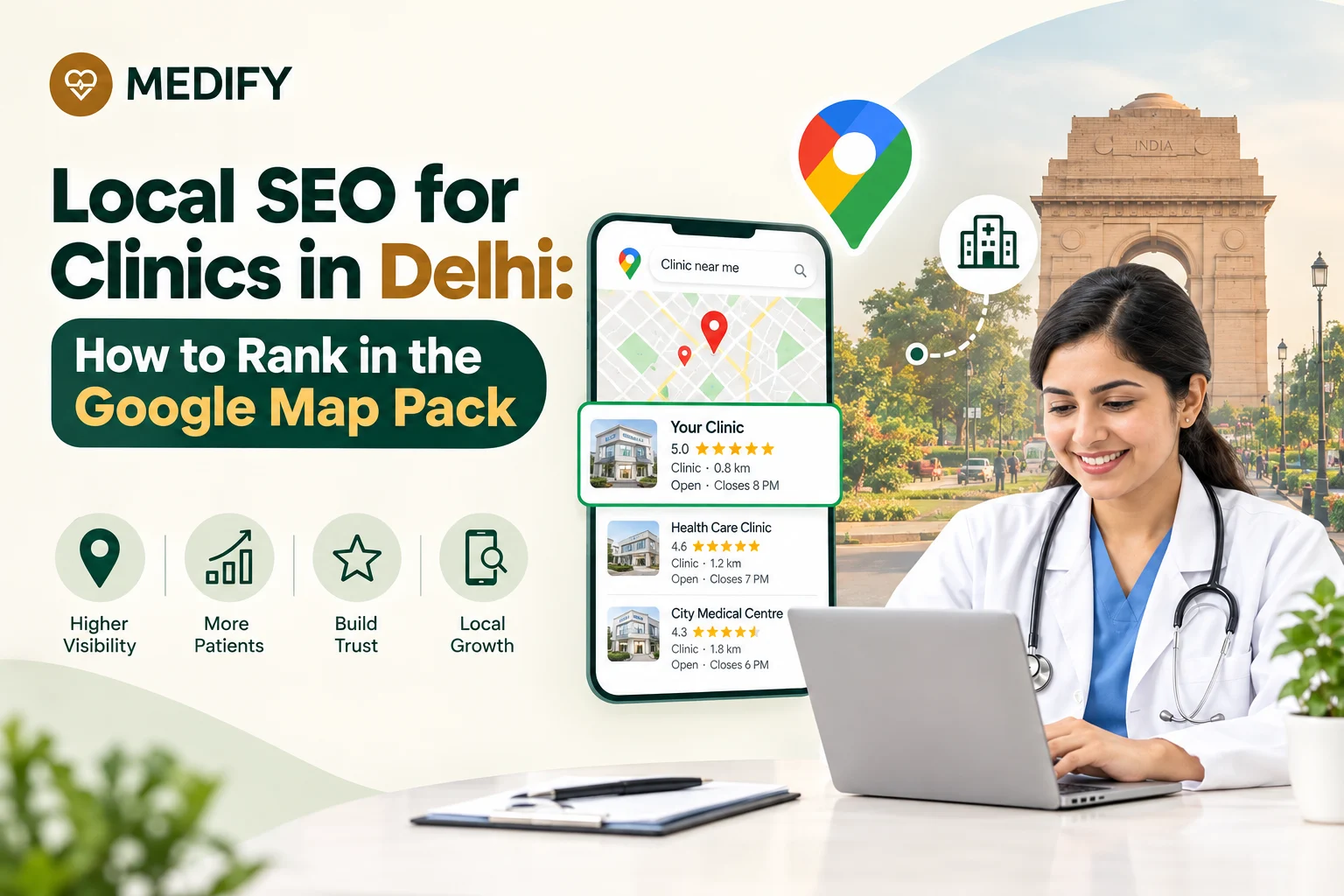
Search “clinic near me” or “[speciality] in [Delhi neighbourhood]” and the first thing you see isn’t a list of websites — it’s the Map Pack, the three clinics shown with a map, ratings, and a “Directions” button. That’s where most patients click. If your clinic isn’t one of the three, you’re invisible at the exact moment a patient is ready to act. Here’s what actually determines who gets into that box, and how to get your clinic there.
What the Map Pack Actually Rewards
Google ranks Map Pack results on three factors: relevance (how well your profile matches the search), distance (how close you are to the searcher), and prominence (how well-known and well-reviewed your clinic is, both on Google and across the web). You can’t change your clinic’s physical location, but relevance and prominence are almost entirely within your control — and that’s where most Delhi clinics are leaving visibility on the table.
Step 1: Optimise Your Google Business Profile Completely
This is the foundation everything else builds on.
- Claim and verify your listing if you haven’t.
- Choose the right primary category — “Multispeciality Clinic,” “Dermatology Clinic,” or the most specific category that matches what you actually do, not a generic “Medical Clinic” label.
- Add secondary categories for every additional speciality you offer.
- Fill in every available field — hours, services, accepted insurance, accessibility features, and a detailed business description using natural language (not keyword-stuffed).
- Upload real photos — your actual reception area, doctors, and facility. Stock photos hurt credibility and Google favours profiles with genuine, regularly updated images.
- Post updates weekly — even a short update about a new service or doctor joining signals an active profile.
Step 2: Reviews Are a Direct Ranking Factor, Not Just Social Proof
Google explicitly factors review count, rating, recency, and how you respond into Map Pack rankings. A clinic with 150 recent reviews at 4.6 stars will typically outrank one with 20 reviews at 4.9 stars, purely on volume and recency signals.
- Build review requests into your actual patient workflow — a simple WhatsApp message after a positive visit works far better than hoping patients remember on their own.
- Respond to every single review. For negative ones, stay calm and professional, and never disclose patient details in your response — this is both good practice and a compliance requirement.
- Never use fake or incentivised reviews. Google actively detects unnatural review patterns and can suppress or suspend profiles found doing this.
Step 3: Local Citations — Get Your NAP Consistent Everywhere
NAP (Name, Address, Phone number) consistency across the web is a foundational local SEO signal.
- List your clinic on Practo, Justdial, Sulekha, and speciality-relevant medical directories.
- Make sure your clinic name, exact address, and phone number match character-for-character across every listing — Google cross-references these, and inconsistencies (a different suite number, a missing landmark, “Rd” versus “Road”) can quietly undermine your prominence signal.
- If you’ve moved locations or changed your phone number recently, audit old directories for outdated listings that are still live.
Step 4: On-Site Local SEO That Supports the Map Pack
Your website reinforces what Google sees in your Business Profile.
- Include your clinic’s name, address, and a Google Map embed on your contact page.
- Create dedicated pages for each speciality or service, with location naturally worked into the content — not stuffed, just present the way a real clinic would describe itself.
- If you serve multiple Delhi neighbourhoods or have multiple branches, build a separate, genuinely useful page for each location rather than one generic page trying to cover all of them.
- Keep page load speed fast — mobile users searching “near me” queries expect an almost-instant experience, and slow pages lose patients before they finish loading.
Step 5: Local Backlinks and Community Signals
Links from other credible, locally relevant websites strengthen your prominence.
- Get listed on hospital or medical-association directories if your clinic is affiliated with one.
- Local health blogs, community publications, or business associations in your area are worth reaching out to for genuine mentions.
- Sponsorships or partnerships with local events (health camps, wellness drives) often naturally generate these kinds of links.
Single-Location Clinic vs. Multi-Location Clinic Chain
The steps above hold for both, but execution needs to differ.
If you run a single clinic, your entire local SEO effort concentrates on one Google Business Profile and one set of citations — which makes this genuinely manageable to get fully right, since there’s no complexity from multiple listings to coordinate. Put the effort into depth: a completely filled-out profile, a steady stream of reviews, and a website that clearly serves your one location well.
If you run multiple clinic locations across Delhi, the temptation is to create one Google Business Profile and list every branch as a service area — this almost always backfires. Google’s guidelines require a separate, individually verified profile for each physical location, and trying to shortcut this typically results in profiles getting suppressed or merged incorrectly. Each location needs its own complete profile, its own dedicated website page (not a shared page listing all branches), and ideally its own local citations reflecting that specific address. Yes, this is more work — but it’s the only way each location actually shows up when a patient searches near that specific branch rather than your flagship location alone.
Delhi Neighbourhood Notes Worth Knowing
A few patterns worth factoring into your local SEO priorities depending on where your clinic sits:
- South Delhi (Saket, GK, Vasant Kunj) — high density of established, well-reviewed clinics and hospitals. Expect to need a genuinely strong review count (100+) and a fully optimised profile just to compete for the Map Pack’s top three in common specialities.
- West Delhi (Dwarka, Janakpuri, Rajouri Garden) — a mix of long-established family clinics and newer entrants; profiles that are fully optimised and actively maintained often outrank older, more established clinics that have neglected their Google presence.
- East and Outer Delhi — generally less digitally competitive, meaning the fundamentals (a complete profile, consistent reviews) can produce a faster, more noticeable jump into the Map Pack than the same effort would in South Delhi.
None of this changes the steps involved — it just tells you how much effort realistically stands between where you are now and page-one visibility.
A Quick Map Pack Health Check
- Is your Google Business Profile 100% complete, with the right primary category?
- Do you have a consistent flow of new reviews, not just a batch from a year ago?
- Are you responding to every review within a few days?
- Is your NAP identical across every directory listing?
- Does your website have a dedicated, genuinely useful page for each location and speciality?
Run through this list honestly, and you’ll usually find one or two clear gaps — that’s typically all it takes to start moving into or up the Map Pack for your key searches.
When to Get Help
Local SEO fundamentals are manageable in-house with consistent effort, but most clinics plateau once competitors in the same neighbourhood are actively optimising too — at that point, it becomes a matter of sustained execution rather than a one-time fix. This is built into the SEO foundation of our clinic and hospital marketing packages, alongside the website, ads, and content that support it.
Want a clear picture of exactly where your clinic stands in local search right now? Book a free audit and we’ll walk you through what’s holding your Map Pack visibility back.
FAQs
What are the three factors Google uses for Map Pack rankings?
Relevance (how well your profile matches the search), distance (proximity to the searcher), and prominence (how well-known and well-reviewed your clinic is). Distance is fixed, but relevance and prominence are both within your control.
How many Google reviews does a clinic need to rank well?
There’s no fixed number, but review volume, recency, and response rate all matter more than an isolated high rating. A steady, ongoing flow of reviews outperforms a large batch collected once and never repeated.
Does having multiple clinic locations hurt or help local SEO?
It helps, provided each location has its own accurate Google Business Profile and a dedicated website page — trying to represent multiple locations with one generic profile or page usually hurts visibility for all of them.
How long does it take to rank in the Map Pack?
Most clinics see movement within 60–90 days of consistent optimisation, though highly competitive Delhi neighbourhoods with many established clinics in the same speciality can take longer to break into the top three.